
How to Coordinate Mail-Order and Local Pharmacy to Save Money on Medications
 Dec, 7 2025
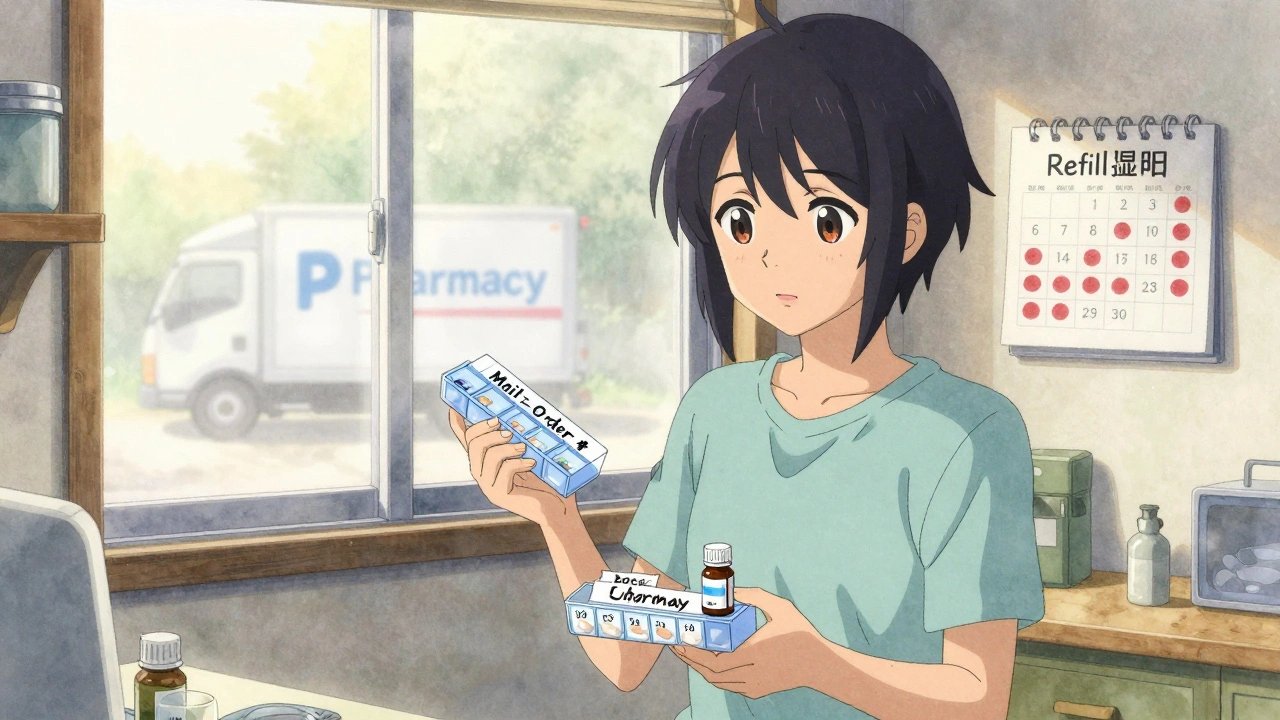
Managing prescription costs doesn’t mean you have to choose between convenience and savings. Many people assume they must stick with their local pharmacy for every refill-but that’s not true. By smartly splitting your medications between mail-order pharmacy and local pharmacy, you can cut your monthly drug bills by hundreds of dollars a year without sacrificing access or safety.
Understand What Medications Belong Where
Not all prescriptions are created equal. The key to saving money is grouping your meds into three simple categories:- Maintenance medications: Drugs you take every day for long-term conditions-like high blood pressure, diabetes, cholesterol, or thyroid meds. These are perfect for mail-order.
- Acute or short-term meds: Antibiotics, pain relievers after surgery, or steroid courses. These need to be picked up fast-stick with local pharmacies.
- Variable-dose meds: Medications your doctor might adjust often, like antidepressants or insulin. Keep these local until your dose is stable.
Why? Mail-order pharmacies deliver 90-day supplies at a lower cost per day, but they take 7-14 days to arrive. If you need a new prescription right away, waiting isn’t an option. A 2007 study in the Journal of Managed Care Pharmacy found mail-order saved patients 29% on average for maintenance drugs compared to 30-day retail fills. For something like amlodipine (a common blood pressure pill), that could mean paying $15 for 30 days at the corner pharmacy versus $40 for 90 days through mail-order-saving you $5 a month, or $60 a year, on just one drug.
Check Your Insurance Plan’s Rules
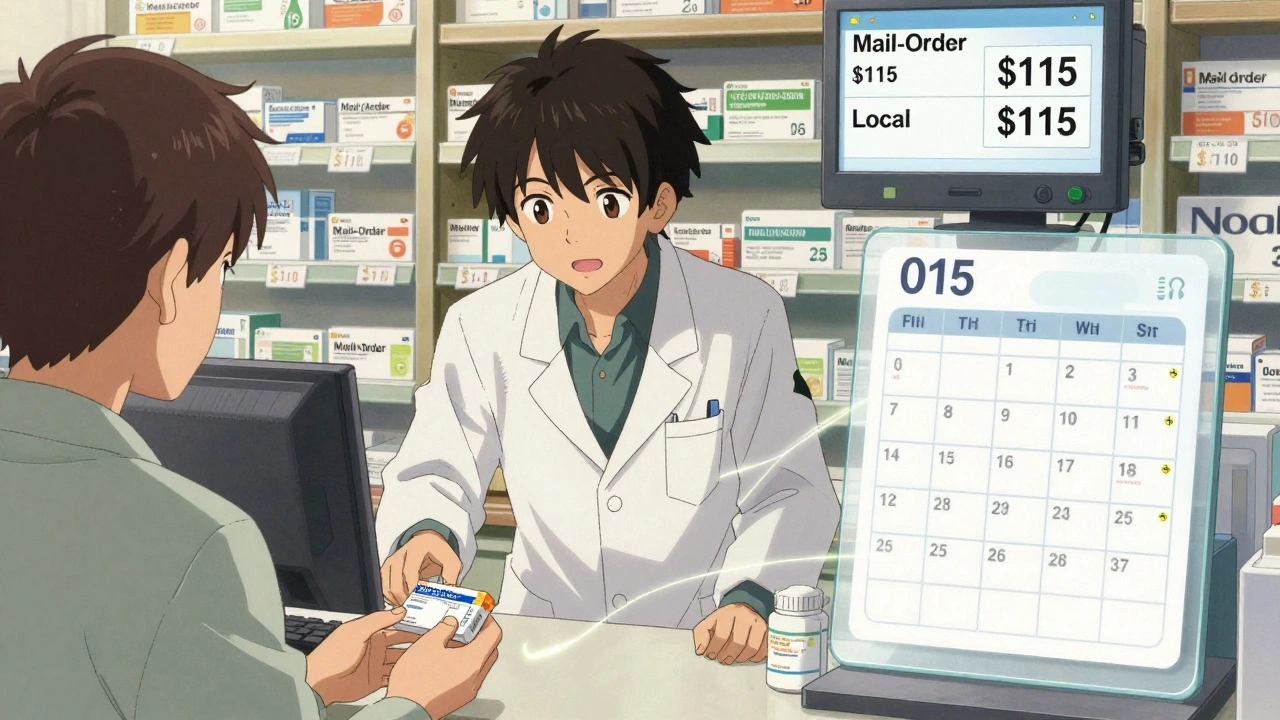
Your insurance doesn’t treat mail-order and local pharmacies the same. Most plans use a tiered formulary system. If your drug is on Tier 2 or 3 (preferred or non-preferred brand), you’ll often pay less for a 90-day supply through mail-order. For example:- 30-day retail copay: $45
- 90-day mail-order copay: $115
That’s not $135 vs. $115-it’s $45 per month vs. $38 per month. You’re saving $7 per month on just one medication. And if you’re on Medicare Part D, you can compare exact prices using the Medicare Plan Finder tool. Don’t assume your plan automatically gives you the best deal. Call your insurer and ask: “What’s my copay for a 90-day supply of [medication name] through mail-order versus retail?”
Here’s the twist: many local pharmacies now offer 90-day fills at the same price as mail-order. CVS, Walmart, and Rite Aid all have programs where you can get 90-day generic prescriptions for $10-$15 without insurance. Ask your local pharmacist: “Can I get a 90-day supply of this for the same price as mail-order?” You’d be surprised how often the answer is yes.
Use Mail-Order for Stable, Long-Term Drugs
If you’ve been on the same dose of metformin, lisinopril, or atorvastatin for over six months, it’s time to switch to mail-order. These drugs don’t change often. You know how they work for you. Mail-order is designed for exactly this scenario.Express Scripts, CVS Caremark, and other major mail-order providers charge as little as $12.50 for a 90-day generic. Walmart’s $10 generic program lets you get 90-day supplies without insurance. That’s $4.17 per month for a drug that might cost $45 at a local pharmacy. Multiply that across three or four maintenance meds, and you’re saving $100-$200 a year easily.
But timing matters. Don’t wait until you’re out. Set a reminder 10-14 days before your current supply runs out. That gives the mail-order pharmacy time to process and ship your refill. Many users on Reddit’s r/personalfinance report saving hundreds annually just by setting calendar alerts on their phone. One person saved $427 a year by switching their blood pressure med to mail-order and never running out.
Keep Acute and New Prescriptions Local
Need an antibiotic after a sinus infection? Got a new painkiller after surgery? Or your doctor just changed your antidepressant dose? Go local.Mail-order pharmacies can’t adjust doses. If your doctor changes your insulin dose or adds a new drug, the mail-order system might keep sending the old version. One user on HealthUnlocked got two months of the wrong antidepressant strength because the pharmacy’s system didn’t sync with their electronic health record. They ended up throwing away $65 worth of pills.
Local pharmacies also offer something mail-order can’t: face-to-face advice. Pharmacists can check for interactions, explain side effects, or tell you if there’s a cheaper alternative. A 2011 study found 78% of patients preferred talking to a pharmacist in person. That’s not just comfort-it’s safety.
Plus, some drugs are too sensitive for shipping. Insulin, biologics, and certain liquid medications can lose potency if exposed to heat or cold during transit. The FDA warns that temperature-sensitive drugs should be delivered in controlled conditions-which most mail-order services can’t guarantee. Stick with local pharmacies for these.
Build a Relationship With One Local Pharmacist
You don’t need to visit a different pharmacy every time. Pick one local pharmacy you trust and stick with them. Let them know you’re using mail-order for maintenance meds. Ask them to:- Keep a full list of all your prescriptions (even mail-order ones)
- Alert you if a drug you take is going generic or price drops
- Run a free annual medication review
The American Pharmacists Association says about 40% of patients could save over $200 a year just by doing this. Pharmacists see patterns you miss. Maybe your blood pressure med has a cheaper generic now. Or your cholesterol drug just got a 90-day discount at your local store. They’ll tell you.
Track Your Savings and Watch for Changes
It’s easy to forget how much you’re saving-until your plan changes. Insurance companies tweak formularies, copays, and preferred pharmacies every year. Medicare Part D plans change annually in October. Commercial plans often update in January.Set a reminder every six months to:
- Check your latest benefit statement
- Compare copays for each maintenance drug across mail-order and local
- Ask your pharmacist if any of your meds have new discount programs
According to GoodRx’s 2023 survey, 68% of people who coordinated their pharmacy use saved at least $150 a year. The top 32% saved over $300. That’s not luck-it’s strategy.
One user switched their diabetes meds from mail-order to local after their plan raised the mail-order copay. They found the same drug at Walmart for $10 for 90 days. They saved $180 in six months.
What to Avoid
Don’t fall into these traps:- Assuming mail-order is always cheaper-some specialty drugs cost more through mail-order. Always compare.
- Letting your meds run out-mail-order delays can leave you without treatment. Set reminders.
- Ignoring local pharmacy discounts-Walmart, Costco, and Kroger have $4-$10 generic programs. Use them.
- Not telling your pharmacist about mail-order fills-they need the full picture to catch interactions.
Also, avoid switching too often. If you’re stable on a drug, don’t jump back and forth between pharmacies. It confuses records and increases error risk.
The Future Is Integrated
By 2025, most insurance plans will offer unified pharmacy networks. UnitedHealthcare’s Optum Perks and Express Scripts’ new “Pharmacy Choice” program let you switch between mail-order and local with synced refill schedules. Medicare’s 2024 redesign will standardize 90-day pricing across channels.But for now, the system still requires you to be proactive. You’re not just a patient-you’re a manager of your own care. The tools are there. The savings are real. You just need to use them.
Can I get 90-day supplies at my local pharmacy instead of mail-order?
Yes. Many local pharmacies-including Walmart, CVS, and Rite Aid-offer 90-day fills at the same price as mail-order, especially for generics. Ask your pharmacist directly. You don’t need to use mail-order to get the lower rate.
What if my insurance doesn’t cover mail-order?
Even if your plan doesn’t promote mail-order, you can still use it. Some plans require you to opt in. Call your insurer and ask: “Can I use mail-order for my maintenance meds?” If they say no, ask if they offer a 90-day retail option at the same cost. Many do.
How do I know if a drug is stable enough for mail-order?
If you’ve been on the same dose for at least 6 months, with no side effects or adjustments, it’s likely stable. Common examples: blood pressure, cholesterol, thyroid, and diabetes meds. If your doctor changes your dose often, keep it local until it’s settled.
Are mail-order medications safe?
Yes, for most medications. But avoid mail-order for temperature-sensitive drugs like insulin, biologics, or liquid antibiotics. These need controlled shipping. Stick with local pharmacies for these. Also, make sure your mail-order provider is licensed and accredited by the National Association of Boards of Pharmacy (NABP).
How much can I realistically save each year?
Most people save $150-$300 a year by coordinating pharmacy use. If you take three or four maintenance drugs, switching them to mail-order or discounted local 90-day fills can save $50-$100 per drug annually. That’s $200-$400 total. Users who combine this with pharmacy discount programs often save even more.
Christian Landry
December 8, 2025 AT 18:42Evelyn Pastrana
December 10, 2025 AT 13:36Rich Paul
December 11, 2025 AT 22:44Michael Robinson
December 12, 2025 AT 19:28Mona Schmidt
December 13, 2025 AT 00:50Andrea DeWinter
December 14, 2025 AT 09:57Steve Sullivan
December 14, 2025 AT 20:35ian septian
December 15, 2025 AT 02:16Guylaine Lapointe
December 15, 2025 AT 02:39Katie Harrison
December 15, 2025 AT 14:38Graham Abbas
December 17, 2025 AT 06:54George Taylor
December 18, 2025 AT 21:56Kathy Haverly
December 19, 2025 AT 20:26Andrea Petrov
December 20, 2025 AT 17:41