
How to Create a Daily Medication Routine You Can Actually Stick To
 Dec, 28 2025
Imagine this: you wake up, take your blood pressure pill, and by noon, you’ve already forgotten about the next one. By dinner, you’re not sure if you took it at all. You’re not alone. About half of people with chronic conditions miss doses at least sometimes. It’s not laziness. It’s not forgetfulness alone. It’s that most medication schedules are designed for a perfect world - one where you have perfect memory, no distractions, and a rigid routine. The truth? You need a routine that fits your life, not the other way around.
Start with What You Already Do
The most effective way to remember your meds is to tie them to something you already do every day without thinking. Brush your teeth? Eat breakfast? Feed your dog? These are your anchors. Stanford Medicine found that 78% of people who linked their pills to a daily habit stuck with them. That’s not luck. It’s how the brain works. When you pair a new action with an old one, the old one becomes a trigger.Don’t just say, “I’ll take my pill at 8 a.m.” That’s too vague. Say, “I’ll take my morning pill right after I finish brushing my teeth.” Or, “I’ll take my evening pill as soon as I sit down for dinner.” The more specific and sensory the trigger, the better. The taste of toothpaste. The smell of coffee. The sound of your cat meowing for food. These cues stick.
Use a Pill Organizer - But Do It Right
A simple pill box isn’t just a container. It’s your visual backup. A weekly organizer with separate compartments for morning, afternoon, and night cuts missed doses by up to 35%, according to the American Heart Association. But most people use them wrong. They fill them once a month. Or they mix up the days.Here’s how to do it right: set aside 20 minutes every Friday night. That’s the sweet spot. Most people have fewer obligations on Friday evenings. Lay out all your bottles. Read the labels. Fill each compartment for the next week. Put the Sunday doses on top so you can see them. If you’re taking multiple pills at once, use a pill splitter or ask your pharmacist to pre-sort them. Some pharmacies offer this for free.
Pro tip: Use colored labels. Blue for morning, red for afternoon, yellow for night. A 2021 American Heart Association study showed this helped patients with memory issues get the right dose 28% more often. If you’re colorblind, use symbols instead: a sun for morning, a moon for night.
Set Alarms - But Don’t Rely on Them Alone
Smartphones are great for reminders. A 2020 MedStar Health study found 63% of people aged 50-75 improved adherence using phone alarms. But here’s the catch: if you’re over 75, only 45% of people still use them correctly. Why? Phones get silenced. Notifications get ignored. Batteries die.Don’t just set one alarm. Set two. One for when you usually wake up. One for when you usually eat lunch. Make them different sounds. One beeps. One rings. One vibrates. And pair it with your habit. Set the alarm for “after brushing teeth,” not “at 8 a.m.” That way, even if you miss the alarm, the habit still triggers you.
For older adults or anyone who finds tech frustrating, try a timer cap. These screw onto pill bottles and beep when it’s time to take your medicine. No phone needed. No app to download. Just a simple beep. They work for 62% of users across all ages, according to ProMedica’s 2023 data.
Track It - But Keep It Simple
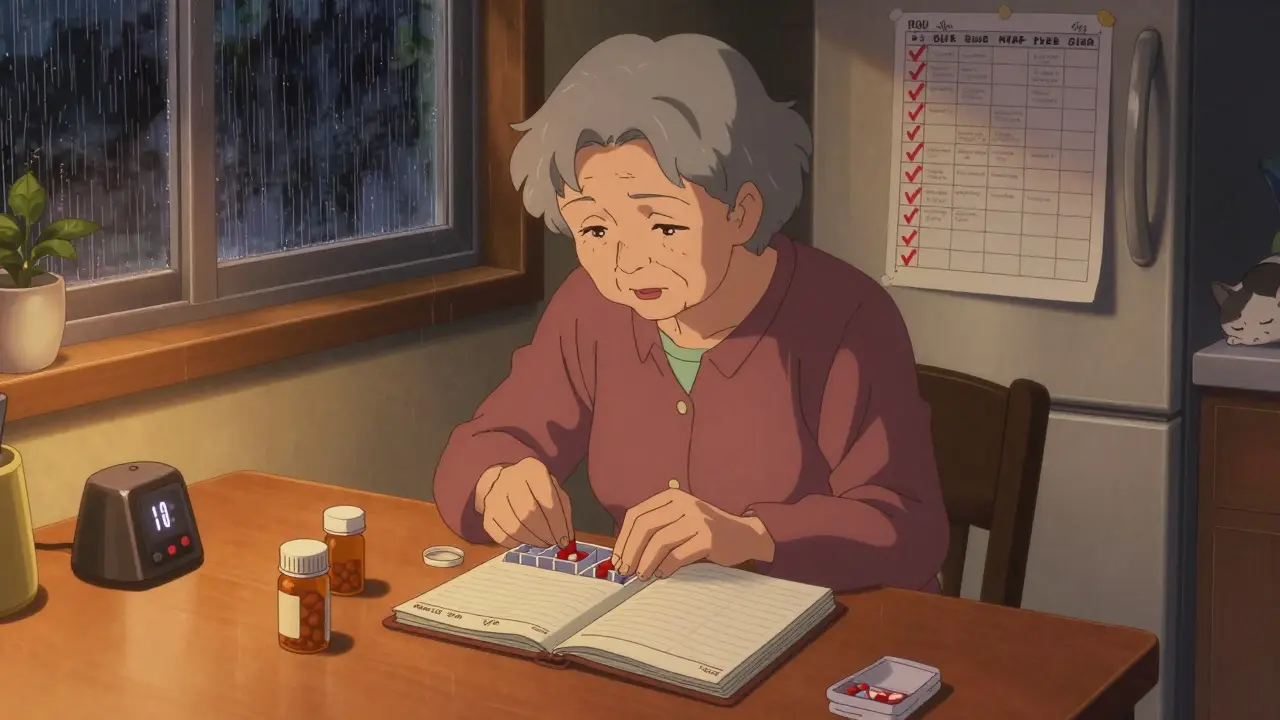
Writing things down works. A 2011 study in PMC showed that people who checked off each dose on a calendar reduced missed pills by 32%. But don’t overcomplicate it. You don’t need a fancy app or a journal with 10 columns. Just print out a free weekly chart. Put it on your fridge. Use a marker. Check off each dose as you take it.Some people like to use stickers. Others use a dry-erase board. One patient on Reddit said filling her pill box every Friday night became her ritual - and her missed doses dropped from 30% to under 5%. The ritual mattered more than the tool.
Don’t track for perfection. Track for patterns. If you keep missing your afternoon pill, maybe it’s because you’re rushing after work. Maybe you need to move it to right after you get home. Adjust. Your routine isn’t set in stone. It’s a tool. Tweak it until it fits.
Simplify Your Regimen
If you’re taking five pills a day, spread across three times a day, it’s no wonder you’re overwhelmed. Dr. Robert L. Page II, a medication expert at the University of Colorado, says the most successful routines are the simplest. One pill once a day beats three pills three times a day every time.Ask your doctor or pharmacist: “Can any of these be combined? Can I take this one with food so I can tie it to breakfast?” Many medications can be taken together safely. Some can be switched to extended-release versions. A 2022 MedStar Health study found that patients who consolidated their doses cut their daily pill count by 30-50% without losing effectiveness.
Don’t assume your current schedule is final. Medication regimens change. Your life changes. Your body changes. Revisit your routine every three months. Bring your pill box to your next appointment. Ask: “Is this still the best way?”
Plan for Disruptions
Travel. Holidays. Sick days. Power outages. These are the moments routines break. And 63% of patients say disruptions are their biggest adherence problem.Before you leave the house, pack your pills. Use a travel pill organizer - the small, lockable kind. Keep it in your bag, not your suitcase. If you’re flying, carry your meds in your carry-on. Never check them.
For holidays or weekends when your routine shifts, plan ahead. If you’re sleeping in, take your morning pill after breakfast, not at your usual time. If you’re going out for dinner, take your evening pill right before you leave. Flexibility keeps you on track.
Know When You’re Skipping on Purpose
Sometimes, you don’t forget your meds. You just don’t want to take them. Maybe they make you dizzy. Maybe they give you stomach pain. Maybe you think they’re not working. That’s intentional non-adherence. And it’s dangerous.Don’t stop taking them. Don’t cut the dose. Talk to your provider. Side effects can often be managed - a different time of day, a lower dose, a different brand. A 2023 AdventHealth survey found that 49% of patients skipped meds because of side effects. But 72% of them said their symptoms improved after talking to their doctor.
Your health is worth the conversation. You’re not being difficult. You’re being honest. And that’s the first step to fixing it.
It’s Not About Willpower - It’s About Design
You don’t need to be more disciplined. You need a better system. The goal isn’t to remember every pill every day. The goal is to make forgetting impossible.Put your pill box where you’ll see it. Set two alarms. Link your meds to brushing your teeth. Fill your organizer on Friday nights. Talk to your doctor about simplifying your list. Track your progress with a simple checkmark. And if you miss a dose? Don’t panic. Don’t guilt-trip yourself. Just take the next one on time. Then reset.
Medication adherence isn’t about perfection. It’s about progress. One day at a time. One habit at a time. And if you stick with it, you’re not just taking pills - you’re taking control.
What’s the easiest way to remember my daily meds?
The easiest way is to link your pills to a daily habit you already do without thinking - like brushing your teeth, eating breakfast, or feeding your pet. Pairing your medication with a consistent, sensory-rich routine makes it automatic. Studies show this method improves adherence by 78%.
Are pill organizers worth it?
Yes, especially weekly organizers with separate compartments for morning, afternoon, and night. They reduce missed doses by up to 35%, according to the American Heart Association. Fill them every Friday night - it’s the most effective time for most people. Use colored labels or symbols to avoid mix-ups.
I use my phone alarms, but I still forget. What else can I do?
Phone alarms alone aren’t enough. Set two different alarms with different sounds. Pair them with a habit - like “after I pour my coffee.” If you’re over 75 or find phones confusing, try a timer cap that beeps on your pill bottle. It works without a phone and is effective for 62% of users.
Can I reduce how many pills I take each day?
Yes. Talk to your doctor or pharmacist about combining medications, switching to extended-release versions, or adjusting doses. Many people can cut their daily pills by 30-50% without losing effectiveness. Simplifying your regimen is one of the most powerful ways to improve adherence.
Why do I keep missing my afternoon dose?
Afternoon doses are often missed because they fall between activities - after work, before dinner. Try moving it to right after you get home, or right before you eat lunch. If you’re busy, use a timer cap or put your pill box on your desk. The key is to tie it to a new, consistent trigger.
What if I don’t like taking my meds because of side effects?
Don’t stop taking them. Side effects are common - but they’re not always permanent. Talk to your provider. You might need a different time of day, a lower dose, or a different medication. In one study, 72% of people who spoke up saw their side effects improve. Your health depends on this conversation.
How do I handle meds when traveling?
Pack a travel pill organizer with enough pills for your trip plus a few extras. Keep it in your carry-on. Set alarms for your new time zone. If you’re crossing time zones, take your pill at the same clock time, not the same local time. For example, if you usually take it at 8 a.m. home time, take it at 8 a.m. your new time zone.
Should I use a medication app?
Apps can help - but only if you’ll use them. Many people stop using them after a few weeks. If you’re tech-savvy and like tracking, go for it. If not, stick with a physical pill organizer and a printed calendar. Low-tech tools work better for most people, especially those over 65.
If you’re taking multiple medications, you’re not alone. Nearly half of adults between 40 and 79 take two or more prescriptions. But you don’t have to let it overwhelm you. Start small. Pick one habit. One organizer. One alarm. Build from there. Your body doesn’t need perfection. It needs consistency. And that’s something you can build - one day, one pill, one habit at a time.
Teresa Marzo Lostalé
December 30, 2025 AT 09:03God, I love this. I used to forget my meds like it was a hobby - until I started taking them right after I brush my teeth. Now the minty taste is my cue. No alarms. No apps. Just toothpaste and peace. 🙌
Bradly Draper
December 31, 2025 AT 22:22This is the first time I’ve read something about meds that didn’t make me feel like a failure. I’ve been taking my pills after I pour my coffee for six months now. Still mess up sometimes, but way less. Thanks for saying it’s about design, not willpower.
Gran Badshah
January 1, 2026 AT 09:07Why do you guys even need all these gadgets? In India we just use a small tin box and write the days on it with a marker. No color codes, no alarms, no Friday night rituals. Just simple. Your Western overcomplication is hilarious.
Ellen-Cathryn Nash
January 2, 2026 AT 11:35Let me be clear - if you’re skipping meds because you ‘don’t like the side effects,’ you’re not being honest, you’re being selfish. Your body didn’t ask for this illness. You didn’t ask for the pills either - but they’re there to keep you alive. Stop treating your health like a mood ring. 🤦♀️
Samantha Hobbs
January 3, 2026 AT 06:38OMG I just tried the Friday night pill fill and it changed my LIFE. I used to be so stressed every Monday morning thinking ‘did I take Tuesday’s?’. Now I just grab my box and go. I even bought a cute one with a lock. Yes, I’m that person now. 🎉
Nicole Beasley
January 3, 2026 AT 14:23Just started using a timer cap! 🎯 It beeps like a microwave when it’s time. So satisfying. Also, I put my pill box next to my coffee maker - now my cat sits on it like it’s a throne. She’s my pill reminder. 🐱💊
sonam gupta
January 5, 2026 AT 07:04Why do you need a whole article for this? Take your pills when you eat. That's it. No apps no boxes no colors. Your culture makes simple things complicated. We live with less and still survive.
Julius Hader
January 5, 2026 AT 19:43I tried the pill organizer. It worked for two weeks. Then I got lazy. Then I stopped. Then I started again. Then I stopped. Then I started again. I’m not broken. I’m just human. And I’m still here. That’s what matters.
Vu L
January 6, 2026 AT 01:0678% adherence with habit stacking? That’s not science, that’s marketing. I’ve been taking my meds at random times for 12 years and my labs are perfect. Maybe the real problem is doctors overprescribing. Just saying.