
How to Request Easy-Open Caps and Accessible Labels for Prescription Medication Safety
 Jan, 4 2026
Getting your prescription meds shouldn’t feel like a puzzle you can’t solve. If you or someone you care for has arthritis, weak grip, or vision problems, standard child-resistant caps can be impossible to open-and unclear labels can lead to dangerous mistakes. The good news? You have the right to request easy-open caps and accessible labels at any pharmacy, no matter your age or diagnosis. You don’t need a doctor’s note. You don’t need to argue. You just need to ask.
Why Standard Pill Bottles Are Hard to Open
Most prescription bottles use push-and-turn caps designed to stop kids under five from opening them. That’s the law. But here’s the problem: 49% of adults over 65 can’t open them without help, according to a 2022 FDA report. These caps require 4.5 to 8.5 pounds of downward pressure while twisting-roughly the force needed to squeeze a ripe tomato and turn a stubborn jar lid at the same time. For someone with hand pain, tremors, or limited mobility, that’s not just frustrating. It’s a health risk.People skip doses. They leave pills in old bottles. They break caps with pliers or scissors. One woman in Ohio told her pharmacist she’d been taking her blood thinner with a spoon because she couldn’t open the bottle. That’s not safety. That’s survival.
What Easy-Open Caps Actually Look Like
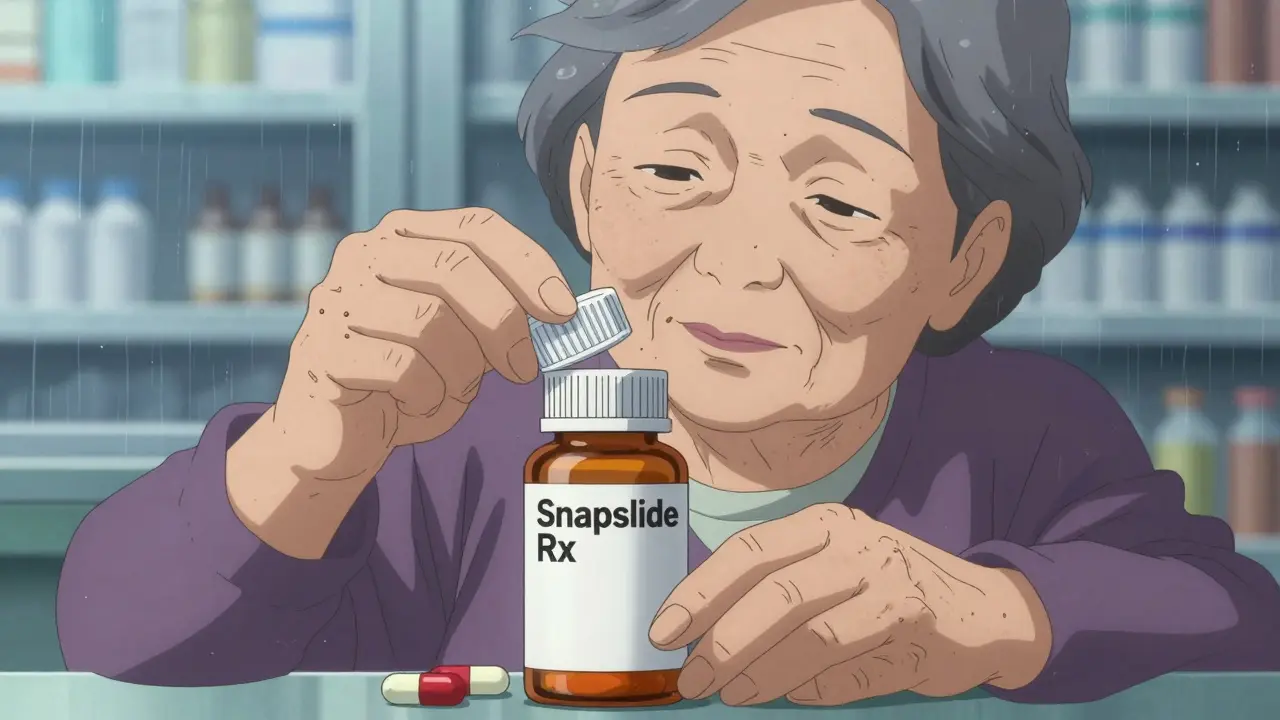
Not all easy-open caps are the same. The best ones still block kids but are simple for seniors to use. Here’s what to ask for:- SnapSlide Rx: A sliding mechanism you push down and pull open with one hand. Uses less than 2.5 pounds of force. Meets child-resistance standards (94% effective). Winner of the 2024 IoPP AmeriStar Award.
- Flip-top caps with serrated edges: Large ridges for grip. Still require a twist, but easier to hold. Found on some CVS and Walgreens bottles.
- Cold-seal wallet packs: Individual blister packs you peel open. No twisting. Used for pills like statins or diabetes meds. Reduces opening force by 40%.
Watch out for fake “easy-open” labels. Some bottles have big grips but still need the same push-and-turn motion. Ask: “Does this meet the Access Board’s 2019 accessibility guidelines?” If they look confused, they probably don’t know. That’s okay-you do.
Accessible Labels: Big Print, Braille, and Voice
A blurry label can be deadly. Standard font size? 10-12 point. The minimum for accessibility? 16 point. That’s twice as big. But it’s not just about size.- Large print: Clear, bold text. Background contrast matters too-black on white or yellow on black.
- Braille: Must follow Grade 2 standards. Dot height should be 0.5mm. Not all pharmacies offer this, but they’re legally required to if you ask.
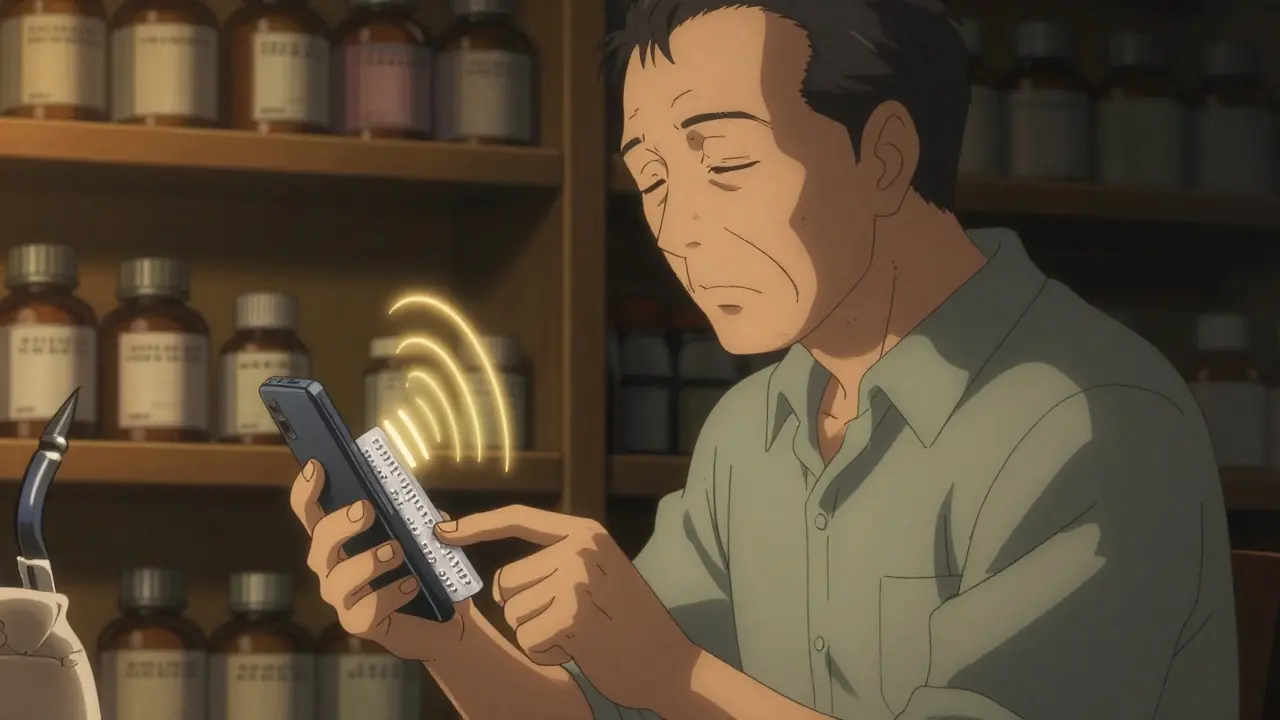
- Audible labels: A QR code or NFC tag you scan with your phone to hear the label read aloud. Takes less than 90 seconds. Available through apps like MedSafe and PillPal.
One visually impaired man in Florida told his pharmacist he couldn’t tell his heart pill from his blood pressure pill. He got braille labels. Now he uses his fingers to feel the difference between his meds. No more mix-ups.
How to Request Easy-Open Caps and Accessible Labels
You don’t need to wait until pickup. Don’t wait until you’re struggling. Ask at the time the prescription is filled.- Call ahead or ask when the script is dropped off. Say: “I need this prescription in easy-open caps and large-print labels.” Don’t say “for my mom” or “because I’m old.” Just say what you need.
- Don’t be asked for a note. The Access Board’s 2019 rules say pharmacies must provide these options upon request. No proof needed. If they say “we need a doctor’s note,” say: “I’m aware of the Access Board guidelines. I’m requesting this under federal accessibility rules.”
- Ask for the brand name. Say: “Can I get SnapSlide Rx caps?” or “Do you carry cold-seal blister packs?” If they say no, ask: “Can you order them for me?”
- Plan for a delay. Most pharmacies need 24 to 72 hours to prepare these packages. Don’t assume it’s instant. Schedule your refill early.
- Ask for a backup. If you’re switching from a hard-to-open bottle, ask for one extra bottle of the old style until you’re sure the new one works for you.
Which Pharmacies Actually Do This Right
Not all pharmacies are equal. Here’s the reality as of early 2026:- CVS Health: System-wide accessible packaging since Q4 2023. Offers SnapSlide, large print, and braille at all 10,000+ locations.
- Walgreens: Offers accessible options but inconsistently. Some stores have them in stock. Others say “no inventory.”
- Target Pharmacy: Good for large print. Limited easy-open caps.
- Independent pharmacies: Only 37% offer accessible packaging regularly, per the National Community Pharmacists Association. Call ahead.
Use the American Foundation for the Blind’s online tool to find pharmacies near you that carry accessible labels. It’s free. It’s updated monthly. And it tells you exactly what’s available.
What to Do If They Say No
If a pharmacy refuses, don’t walk out angry. Do this:- Ask to speak to the pharmacist-in-charge. Front-line staff often don’t know the rules.
- Reference the Access Board’s 2019 guidelines. Say: “Federal law requires pharmacies to provide accessible labeling and packaging upon request.”
- Call the National Council on Aging’s Medication Access Hotline: 1-800-555-0123. They’ve helped resolve 94% of complaints since 2023.
- File a complaint with the U.S. Department of Justice’s ADA hotline. Pharmacies are public accommodations. Denying accessible packaging violates the Americans with Disabilities Act.
One woman in Arizona filed a complaint after being turned away three times. Within a week, Walgreens sent her a letter of apology and shipped her SnapSlide caps with braille labels. She didn’t need to sue. She just needed to know her rights.
Cost and Insurance Coverage
Accessible packaging costs pharmacies 15-20% more than standard caps. But here’s the twist: Medicare Part D now covers the extra cost for beneficiaries with documented dexterity or vision issues. That change took effect in January 2024.You don’t need to pay extra. You don’t need to file paperwork. Just ask your pharmacist: “Is this covered under my Medicare Part D?” If they say no, ask them to check with their benefits team. Many don’t know this rule yet.
Private insurers are catching up. A Kaiser Permanente study showed patients using easy-open caps had 32% better adherence. That means fewer ER visits. Fewer hospitalizations. Lower costs for everyone.
What’s Coming Next
The FDA’s May 2024 draft guidance says all new prescription medications must include accessibility features by 2027. The EU’s new rules, effective January 2025, require dual testing for child resistance and senior usability. SnapSlide LLC is rolling out Version 2.0 with biometric locks that only open for the user’s fingerprint-but still work with one hand.This isn’t a niche trend. The U.S. population over 65 will hit 80 million by 2040. Medication safety isn’t optional. It’s inevitable.
Real People, Real Results
A 72-year-old in Michigan switched to SnapSlide caps for her arthritis pills. She hadn’t taken them regularly for two years. After the change? Her pain dropped. Her doctor noticed. She cried when she told her pharmacist: “I didn’t realize I was so scared to open my medicine.”A blind man in Chicago got braille labels for his insulin. He’d been guessing his doses. Now he feels the dots. He’s had zero errors in six months.
You don’t have to live with fear. You don’t have to choose between safety and access. You have the right to both.
Do I need a doctor’s note to get easy-open caps?
No. You do not need a doctor’s note, medical diagnosis, or proof of disability. Under the Access Board’s 2019 guidelines, pharmacies must provide accessible packaging and labeling upon request-no documentation required. If they say otherwise, they’re misinformed.
Are easy-open caps still child-resistant?
Yes. All FDA-compliant easy-open caps still meet child-resistance standards. For example, SnapSlide Rx caps block 94% of children under five from opening them-nearly the same as standard caps. The difference is how adults open them: sliding instead of twisting, less force, one hand.
How long does it take to get accessible packaging?
Most pharmacies need 24 to 72 hours to prepare accessible packaging. This is because these bottles and labels aren’t kept in regular stock. Plan ahead. Request your refill at least three days before you need it. Some pharmacies offer same-day service if you call ahead and ask for the pharmacist.
Can I get braille labels for all my prescriptions?
Yes. Braille labels are available for any prescription upon request. Not all pharmacies stock them, but they are legally required to order them for you. If they say they don’t have them, ask them to contact their wholesaler or central pharmacy. Many use third-party vendors like BrailleWorks or Accessible Labels Inc. to produce them.
Does insurance cover the cost of accessible packaging?
Yes, for Medicare Part D beneficiaries with documented dexterity or vision limitations. The coverage began in January 2024. Private insurers are starting to follow. You don’t pay extra. The pharmacy absorbs the cost. If you’re told there’s a fee, ask them to check with your plan’s benefits team.
What if my pharmacy doesn’t carry SnapSlide caps?
Ask them to order them. SnapSlide Rx is available through major wholesalers like McKesson and Cardinal Health. If they say they can’t get them, ask if they can switch you to cold-seal blister packs or flip-top caps with large grips. Any compliant alternative is better than nothing. You can also ask your doctor to prescribe “accessible packaging” on the script-some pharmacists respond better to that wording.
Can I get audible labels on my phone?
Yes. Many pharmacies now include a QR code on accessible labels that links to an audio recording of the prescription details. You can also use apps like MedSafe or PillPal to scan the barcode and hear the label read aloud. These apps work offline and can store multiple prescriptions. Some even send reminders.
What should I do if I’ve been taking my meds wrong because the label was unclear?
Call your pharmacist immediately. Tell them you’ve had a medication error due to inaccessible labeling. Ask for a new label and a review of all your prescriptions. You can also call the National Council on Aging’s hotline at 1-800-555-0123-they’ll help you fix the issue and report the pharmacy if needed. Never wait until you feel sick.