
Medication Considerations for Vegans and Vegetarians: Hidden Animal Ingredients
 Dec, 2 2025
Vegan Medication Ingredient Checker
Check Your Medication
Search for specific medications or ingredients to see if they contain hidden animal-derived components.
Search Results
How to use this tool
Always verify with your pharmacist or the manufacturer. Labels don't always specify animal sources. Look for:
- Gelatin (animal-based capsules)
- Magnesium stearate (often animal fat)
- Vitamin D3 (often from lanolin)
- Glycerin (can be animal or plant-based)
- Stearic acid (E570)
For complete verification, check Pill Clarity database.
Most people assume their medications are just chemicals and water-nothing more. But for vegans and vegetarians, that’s not true. Hidden animal ingredients are hiding in plain sight: in your capsules, your supplements, even your daily pills. And unless you ask the right questions, you might be taking something that goes against your values without even knowing it.
What’s Really in Your Pills?
Gelatin is the biggest offender. Around 90% of capsules-those little soft shells you swallow-are made from gelatin, which comes from the bones, skin, and connective tissues of pigs, cows, and chickens. You won’t find it listed as “pig parts” on the label. It’s just “gelatin.” Same with magnesium stearate. About 65% of the time, it’s made from animal fat. It’s used to help pills hold their shape and flow through manufacturing machines. But it’s still fat from slaughtered animals. Vitamin D3 is another surprise. Most supplements use lanolin, a waxy substance pulled from sheep’s wool. It’s processed into vitamin D3, then put into pills. But you don’t need animal products to get Vitamin D3. Plant-based versions made from lichen or green algae exist-and they work just as well. The difference? One is ethical. The other isn’t. Then there’s glycerin. It’s in cough syrups, creams, and pills. It can come from vegetable oil… or animal fat. Stearic acid (E570) is another one. It’s a common filler, and it’s often sourced from cow, sheep, or pig fat. Squalane, found in some topical meds and supplements, is sometimes pulled from shark liver oil. And collagen? That’s literally animal skin and bones boiled down into powder.These Medications Contain Animal Tissue-Not Just Fillers
Some drugs aren’t just hiding animal ingredients in their fillers-they’re made from them. These aren’t optional. They’re the active ingredient. Premarin, a hormone therapy for menopause, is made from the urine of pregnant mares. The horses are kept in confined stalls to collect their urine. There’s a synthetic version called estradiol, which is animal-free, but many doctors still prescribe Premarin by default. Armour Thyroid, used for hypothyroidism, comes from dried pig thyroid glands. It’s not a filler. It’s the medicine. The synthetic alternative, levothyroxine, is vegan. But if you’re used to Armour and feel better on it, switching isn’t always simple. Heparin, a blood thinner, comes from pig intestines. There’s no vegan substitute yet. If you’re on heparin for a clotting disorder, you can’t just swap it out. The same goes for pancrelipase (Creon), which helps digest food in people with pancreatic insufficiency. It’s made from pig pancreas. No plant-based version exists. Propofol, used in anesthesia, contains egg phospholipids. Fish oil supplements like Vascepa are made from anchovies and sardines. Even though they’re called “omega-3s,” they’re still fish.What Can You Actually Replace?
The good news? Many animal-based ingredients have vegan alternatives. It’s not about giving up medicine-it’s about asking for the right version. Gelatin capsules? Switch to cellulose-based ones. Many pharmacies carry them. Ask for “vegetarian capsules” or “plant-based capsules.” They look and taste the same. They just don’t come from animals. Magnesium stearate? Some brands use plant-based versions made from palm or coconut oil. It’s harder to find, but it’s out there. Call the manufacturer. Ask if their stearic acid is from animal or plant sources. Vitamin D3? Skip the lanolin. Look for D3 made from lichen or algae. Brands like Deva Nutrition, Garden of Life, and Nordic Naturals offer these. Check the label. If it says “D3,” dig deeper. If it says “vegan D3 from algae,” you’re good. Glycerin? Look for “vegetable glycerin” on the label. If it just says “glycerin,” call the company. Most big brands now use plant-based versions, but smaller ones still use animal. The key is this: inactive ingredients (fillers, shells, coatings) can usually be swapped. Active ingredients (the actual medicine) often can’t. But even then, there are sometimes alternatives.How to Talk to Your Pharmacist
Don’t just say, “I’m vegan.” That’s not enough. Pharmacists hear that all the time. But they don’t always know what it means for pills. Be specific. Say: “I need medications free of gelatin, magnesium stearate, lanolin, glycerin from animal sources, and any ingredients derived from pigs, cows, sheep, or chickens.” Ask: “Can you check the source of these ingredients?” Ask: “Do you have a vegetarian or vegan version of this?” Pharmacists can often order alternatives. Many now keep vegetarian capsules in stock. Some even have lists of animal-free meds on file.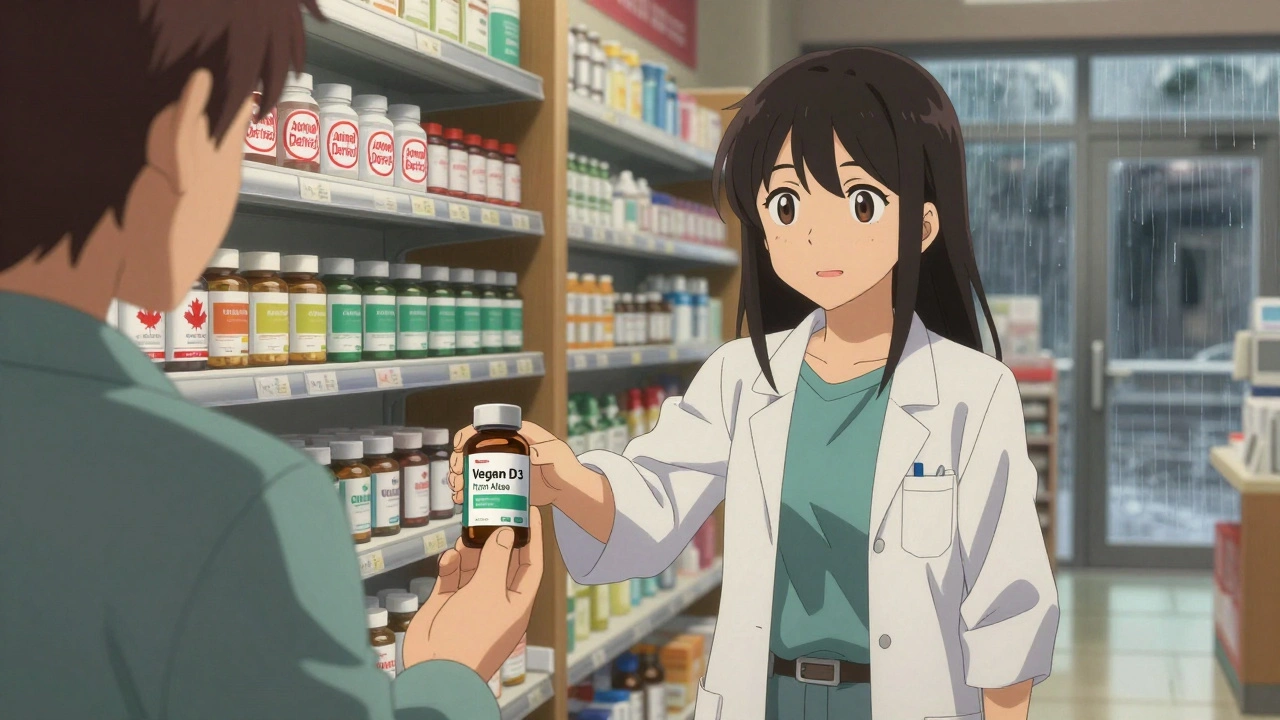
Pill Clarity: A Resource You Can Trust
In 2023, VeganMed changed its name to Pill Clarity. It’s no longer just for vegans. It’s for anyone who wants to know what’s in their medicine. Their database lists thousands of medications and marks which ones are verified animal-free. You can search by drug name, manufacturer, or ingredient. They also certify brands that meet their standards. If a product has the Pill Clarity seal, it’s been verified-no guesswork needed. It’s not perfect. Not every drug is in the system. But it’s the most reliable tool out there.What You Can’t Replace (And How to Handle It)
Some meds have no vegan version. Heparin. Creon. Propofol. These are life-saving. And right now, they’re tied to animal sources. If you need one of these, you’re not failing your ethics. You’re making a medical decision. That’s okay. Talk to your doctor. Ask: “Is there a different treatment path?” For example, if you’re on heparin, is low molecular weight heparin an option? Is there an alternative anticoagulant? Sometimes, yes. For thyroid meds, levothyroxine is vegan and works for most people. If you’ve been on Armour Thyroid and feel fine, don’t panic. But do ask if switching is safe for you. Some people do better on natural thyroid, others on synthetic. It’s personal.Check Your Supplements Too
Supplements are the worst offenders. A 2022 report found that 50% of supplements contain hidden animal ingredients. That’s not a typo. Half. Omega-3s? Fish oil. Not vegan. Probiotics? Some use dairy or egg-based growth mediums. Vitamin B12? Often comes with gelatin capsules. Look for sublingual tablets or liquid forms with plant-based shells. Multivitamins? Many use gelatin or animal-derived colorings. Check the label. If it says “gelatin” or “glycerin” without specifying “vegetable,” assume it’s animal.
What’s Changing?
The vegan population in the U.S. is growing. About 3% of adults now identify as vegan-that’s over 10 million people. And more are asking for animal-free meds. The American Pharmacists Association is starting to train pharmacists on how to handle these requests. New guidelines are expected in 2024. Some manufacturers are responding. More plant-based capsules are being made. More algae-based D3 is hitting shelves. But the system is still slow. Labels don’t have to list animal sources. Companies aren’t required to disclose. That’s why you have to ask.What You Can Do Today
1. Check your current meds. Look at the label. Search for gelatin, stearic acid, glycerin, lanolin, magnesium stearate. 2. Call your pharmacy. Ask if they have vegetarian capsules for your pills. 3. Switch your Vitamin D3 to algae-based. It’s easy. And it’s better. 4. Use Pill Clarity’s website to look up your meds. Type in the name. See if it’s verified animal-free. 5. Talk to your doctor. Say: “I need to avoid animal-derived ingredients. Can we review my meds?” 6. If you’re on a drug with no vegan alternative, don’t feel guilty. Medicine isn’t black and white. Your health matters too.Final Thought
Being vegan isn’t about perfection. It’s about intention. You don’t have to avoid every animal product in every pill to stay true to your values. But you do have the right to know what you’re taking. And you have the power to ask for better options. You’re not alone. Thousands of people are asking the same questions. And slowly, the system is starting to listen.Are all gelatin capsules made from pigs?
No, not all. Gelatin can come from pigs, cows, or chickens. Most capsules use pig gelatin because it’s cheaper and more flexible. But some brands use bovine (cow) gelatin. If you avoid pork for religious or ethical reasons, always ask your pharmacist for the source. Vegetarian capsules made from plant cellulose are widely available and don’t contain animal products at all.
Can I get vegan Vitamin D3?
Yes. Most Vitamin D3 on the market comes from lanolin (sheep wool), but plant-based D3 is made from lichen or green algae. These are vegan, just as effective, and often more sustainable. Look for brands like Deva Nutrition, Garden of Life, or Naturelo that clearly label their D3 as “vegan” or “from algae.” Always check the source-many supplements say “D3” without specifying.
Is levothyroxine vegan?
Yes. Levothyroxine (Synthroid, Tirosint, and generic versions) is a synthetic thyroid hormone made in a lab. It contains no animal tissue. It’s the standard replacement for Armour Thyroid, which is made from pig thyroid glands. Most people do well on levothyroxine, though some prefer the natural version. Talk to your doctor before switching.
Why don’t drug labels list animal ingredients?
U.S. law doesn’t require pharmaceutical companies to disclose the source of inactive ingredients like gelatin, glycerin, or stearic acid. The FDA only requires the chemical name, not the origin. This is different from food labeling, where animal-derived ingredients must be declared. That’s why consumers have to ask pharmacists or manufacturers directly.
What should I do if my medication has no vegan alternative?
If your medication is essential and has no vegan substitute-like heparin, Creon, or propofol-your health comes first. You’re not compromising your values by using it. You’re making a necessary medical choice. Talk to your doctor about long-term options. Sometimes, newer treatments or clinical trials offer alternatives. But never stop a prescribed medication without medical advice.
Is Pill Clarity free to use?
Yes. Pill Clarity’s online database is free to search. You can look up medications by name and see if they’re verified as animal-free. They also offer a mobile app and a pharmacist hotline for personalized help. Their mission is transparency-not profit. They’re funded by grants and partnerships with ethical health organizations.
Are there vegan alternatives to fish oil supplements?
Yes. Algae oil is the only vegan source of EPA and DHA, the same omega-3s found in fish. Brands like Nordic Naturals, Ovega-3, and Garden of Life make algae-based omega-3 supplements. They’re just as effective as fish oil, often purer (no heavy metals), and more sustainable. Always check the label-some “vegan omega-3” products still contain gelatin capsules. Look for plant-based shells too.
shalini vaishnav
December 2, 2025 AT 23:53The idea that vegans should be able to dictate pharmaceutical formulations is absurd. Medicines are not chosen based on dietary ideology-they’re chosen based on efficacy, safety, and biological compatibility. If you want to be vegan, fine. But don’t pretend your ethical stance overrides centuries of medical science. This post is performative virtue signaling wrapped in pseudo-scientific fear-mongering.
And for the record: lanolin is not ‘sheep blood.’ It’s wool wax. You’re not ‘violating’ animals by using it any more than you’re violating trees by using paper.
Stop conflating ethics with convenience.
vinoth kumar
December 3, 2025 AT 16:41I’ve been vegan for 8 years and this is the most practical guide I’ve ever read. Seriously, thank you for laying this out so clearly. I had no idea about magnesium stearate being animal-based-I thought it was just ‘filler.’ Now I always ask for vegetarian capsules. My pharmacist even started keeping a stock of them after I asked twice.
Also, Pill Clarity is a game-changer. I use it before every new prescription. It’s free, it’s reliable, and it doesn’t judge. Just facts.
Keep pushing for transparency. We’re not asking for magic-we’re asking for labeling.
bobby chandra
December 5, 2025 AT 00:40Let’s be brutally honest: the pharmaceutical industry is a labyrinth of unregulated, untransparent, and frankly lazy ingredient sourcing. Gelatin capsules? Outdated. Lanolin-derived D3? Lazy. Animal-sourced heparin? A relic of 1940s biochemistry.
But here’s the kicker-we’re not asking for miracles. We’re asking for *options*. And we’re not asking for them because we’re ‘extreme.’ We’re asking because we’re *informed*. And informed consumers force innovation.
Algae-based omega-3s? Already here. Plant-based D3? Available. Cellulose capsules? Standard in Europe. Why is the U.S. lagging? Because no one’s been loud enough. Until now.
Pharmacists: stop treating vegan requests like a niche oddity. They’re a growing demographic with purchasing power. And yes-we *will* switch brands if you don’t adapt.
Archie singh
December 6, 2025 AT 20:54Gene Linetsky
December 8, 2025 AT 08:48Ever wonder why Big Pharma doesn’t label animal ingredients? Because they’re in bed with the meat industry. Think about it. Gelatin? Pork and beef processors supply them. Lanolin? Wool growers get a cut. The FDA? They’re funded by pharma lobbyists. This isn’t an oversight-it’s a conspiracy.
And don’t tell me ‘it’s just fillers.’ If they can hide it from you, what else are they hiding? Are your antidepressants laced with cow brain extract? Are your blood pressure meds made from chicken bile? You don’t know. And they don’t want you to.
Pill Clarity is the only thing standing between you and corporate poison. Use it. Share it. Fight back.
Ignacio Pacheco
December 8, 2025 AT 16:13So let me get this straight-you’re mad that medicine uses animal byproducts, but you’re fine eating tofu that’s shipped across the globe in plastic containers made from fossil fuels, right?
It’s not hypocrisy. It’s prioritization. You’re choosing convenience over consistency. And that’s fine. But don’t pretend you’re some kind of purity warrior. You’re just a consumer who wants their ethics to be easy.
Also, ‘vegan’ heparin? There isn’t one. Because biology doesn’t care about your Instagram bio.
Jim Schultz
December 9, 2025 AT 11:13Oh, this is *delightful*. A 10,000-word manifesto on the moral purity of pill ingredients, complete with a sidebar on lichen-derived D3, and yet not one mention of the fact that 97% of vegans in the U.S. still take medications containing animal-derived excipients-because they’re either unaware, or they’re too lazy to call their pharmacy, or they’re too afraid of being labeled ‘extreme’ by their doctor.
So let’s be clear: this isn’t about ethics. It’s about guilt. And the real villain here isn’t gelatin-it’s the internalized shame that comes from realizing you can’t live perfectly in an imperfect world.
Also, ‘Pill Clarity’? Sounds like a startup that raised $2M on a pitch deck that said ‘vegans are tired of being lied to.’
And yet… I still use it. Because I’m a hypocrite too.
And I’m okay with that.
Kidar Saleh
December 9, 2025 AT 20:19As someone raised in a household where medicine was treated with reverence-not as a commodity but as a lifeline-I find this conversation deeply moving.
It’s not about rejecting science. It’s about demanding that science evolve to reflect our evolving ethics. We’ve moved from bloodletting to gene therapy. Why not from pig gelatin to cellulose capsules?
My grandmother took Armour Thyroid for 30 years. She never questioned it. But I asked. And now I take levothyroxine. Not because I think she was wrong-but because I have the privilege to ask.
Ask. Always ask. And if they say no? Keep asking. Until they say yes.
This isn’t activism. It’s dignity.
Chloe Madison
December 10, 2025 AT 11:08Just wanted to say-this post saved my life. Not metaphorically. Literally.
I was on heparin for a clotting disorder. I was devastated. I thought I had to choose between my health and my values. I cried for three days.
Then I called my hematologist. I said, ‘I’m vegan. Is there a way to reduce my exposure?’ She didn’t know. But she looked it up. Turns out, low molecular weight heparin has a slightly lower animal content, and we could stagger doses with compression therapy to reduce the total volume.
I didn’t get a vegan version. But I got a better one.
And now I’m helping other vegans navigate this. You’re not alone. And you’re not failing. You’re adapting.
Thank you for writing this. It’s not perfect. But it’s honest. And that’s enough.
Makenzie Keely
December 12, 2025 AT 01:32Here’s what nobody’s saying: The real issue isn’t gelatin or lanolin-it’s that the FDA doesn’t require ingredient sourcing transparency. Period. Not for food. Not for supplements. Not for drugs.
That’s the problem. Not vegans. Not ethics. Not ‘extremism.’
It’s regulatory failure.
So if you’re mad at the system? Don’t yell at vegans. Yell at the FDA. Lobby your congressperson. Demand labeling laws. Because if you’re okay with your blood pressure pill containing cow fat and not knowing it-you’re not being ethical. You’re being passive.
And passive is the opposite of informed.
Be informed. Ask. Demand. Then, if you still need heparin? Take it. Without guilt.
That’s not hypocrisy. That’s human.