
Quality Assurance Concerns in Manufacturing: Why Fears Are Rising in 2026
 Jan, 7 2026
Manufacturing isn’t just about building things anymore. It’s about building trust. And right now, that trust is cracking.
In 2025, 93% of U.S. manufacturers said quality was very or extremely important to their operations. That number jumped to 95% among top executives. But here’s the problem: while everyone agrees quality matters, fewer than half feel confident they can deliver it consistently. The fear isn’t theoretical. It’s in the numbers. Rework costs are eating into margins. Skilled workers are vanishing. And the machines we’re buying aren’t fixing the root issues-they’re just making the noise louder.
Why Quality Is No Longer a Back-Office Task
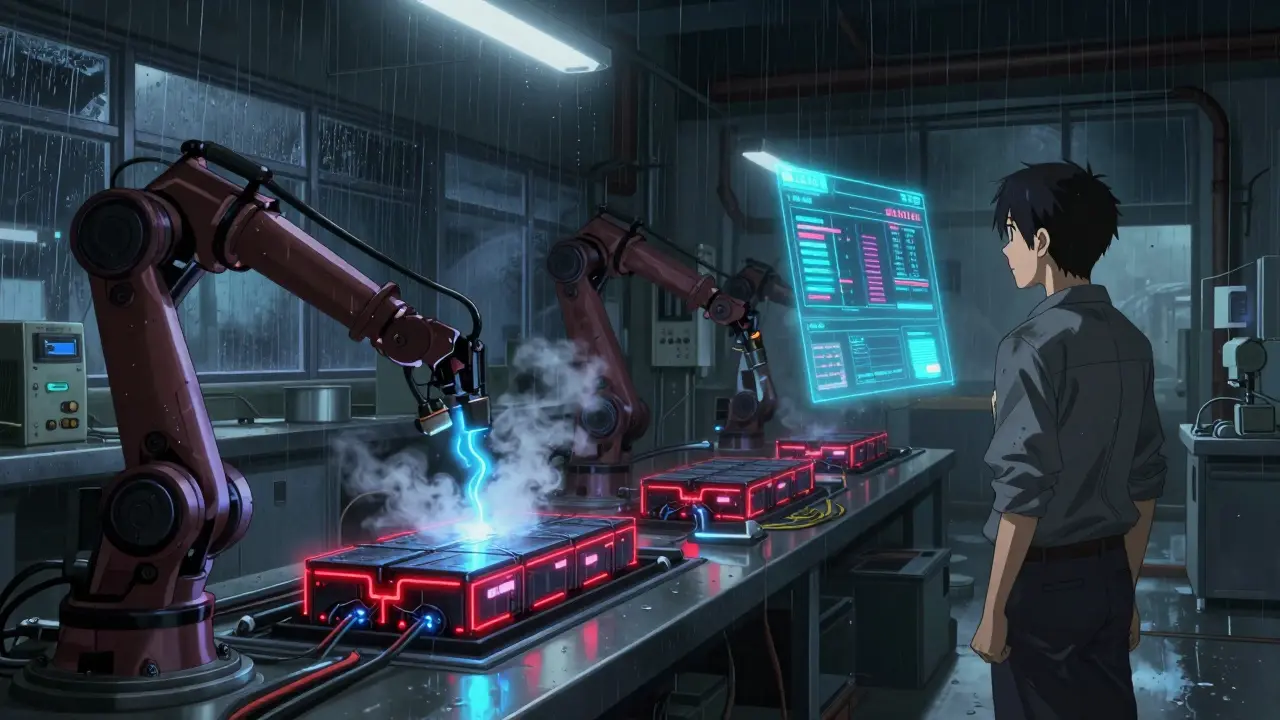
Twenty years ago, quality assurance meant inspectors with calipers checking parts at the end of the line. Today, it’s a live feed from sensors inside a robotic arm assembling an electric vehicle battery. A single misaligned weld can cause a thermal runaway. That’s not a defect-it’s a safety hazard. And customers won’t forgive it.
Companies in aerospace and medical devices already know this. They’ve spent years building systems where every bolt, every wire, every software update is tracked. But the rest of manufacturing? They’re still trying to catch up. The shift isn’t just technological. It’s psychological. Quality is no longer a cost to manage. It’s the reason customers come back. And if you can’t prove you’ve got it under control, they’ll walk away.
The Real Cost of Getting It Wrong
Let’s talk about money. Not the price of raw materials-though that’s up 44% in key sectors-but the hidden cost of mistakes. Rework and iterations are now the second-largest quality challenge for manufacturers, cited by 38% of respondents in the ZEISS 2025 report. That means factories are spending hours, days, even weeks fixing what should’ve been right the first time.
One automotive supplier in Ohio spent $1.8 million last year correcting faulty sensor housings. The root cause? A misaligned camera in their automated vision system. They didn’t train the operators to recalibrate it. They just assumed the machine knew what it was doing. The result? 12,000 defective parts shipped before anyone noticed. The recall cost more than the entire quality department’s annual budget.
And it’s not just about recalls. Time is money too. Forty-seven percent of manufacturers say inspection processes take up too much time. That’s half their workforce sitting idle, waiting for someone to check a dimension that could’ve been verified in real time.
The Technology Trap
Everyone’s buying shiny new tools. AI-powered cameras. 3D laser scanners. Cloud-based quality management systems. Sixty-six percent of manufacturers plan to invest in more than one metrology technology this year. Sounds smart, right?
Except 54% of users on Capterra report longer-than-expected integration times. And here’s the kicker: 40% of companies that spent millions on automation saw higher error rates in their first year. Why? Because they didn’t train the people using the tools.
A medical device maker in Minnesota spent $2.3 million on automated inspection robots. They didn’t hire a single new quality engineer. They didn’t retrain their team. They just flipped the switch. Within six months, false positives spiked. Operators started overriding alerts just to keep the line moving. Defects slipped through. The system became a liability, not a solution.
Technology doesn’t fix culture. It amplifies it. If your team doesn’t trust the data, or doesn’t know how to act on it, the most advanced AI in the world won’t save you.

The Skills Gap Nobody Wants to Admit
Forty-seven percent of manufacturers say the biggest obstacle to quality is a lack of skilled personnel. That’s not just about finding people who can read a blueprint. It’s about finding people who can read data.
Today’s quality engineers need to understand statistics, interpret AI outputs, and troubleshoot robotic systems. The median salary for someone with AI/ML skills in quality roles hit $98,500 in Q2 2025-22% higher than traditional roles. But there aren’t enough people to fill those jobs. The Manufacturing Institute predicts a shortage of 2.1 million workers by 2030, and 37% of those will be in quality-focused roles.
On Reddit’s r/Manufacturing forum, 87% of respondents said their biggest frustration is inconsistent data between departments. One production manager wrote: “I get a quality report from engineering that says the part’s fine. Then the assembly line says it won’t fit. Who do I believe? No one’s talking.”
This isn’t a tech problem. It’s a communication problem. And it’s getting worse.
What Works: The Companies Getting It Right
There are winners. And they’re not the ones spending the most. They’re the ones thinking the most.
One electronics supplier in Michigan implemented AI-enhanced inspection software and saw defect detection improve by 37%. False positives dropped by 29%. The system paid for itself in eight months. How? They didn’t just install it. They put a quality engineer, a production lead, and an IT specialist on the same team from day one. They ran weekly feedback sessions. They let the operators tweak the thresholds. The AI learned from them-and they learned from the AI.
Another company, a medical device maker, cut rework costs by $1.2 million a year by using precise metrology to optimize material usage. They didn’t buy more machines. They just stopped wasting material on parts that didn’t need to be perfect.
These companies share one thing: they treat quality as a team sport. Not a department. Not a checklist. A shared responsibility.

The Future Is Predictive-If You’re Ready
By 2027, 89% of leading manufacturers will use AI to predict quality issues before they happen. That’s not science fiction. It’s already happening in pilot lines.
One automotive plant in Michigan now uses machine learning to analyze vibration patterns in robotic welders. If the pattern shifts by 0.3%, the system flags it before a single part is made. They’ve reduced quality deviations by 27%. That’s not luck. That’s foresight.
But here’s the catch: companies that delay adoption will see defect rates rise 23% by 2027, according to Forrester. And that’s not just a number. It’s lost customers. Lost reputation. Lost market share.
Meanwhile, regulatory pressure is climbing. Sixty-three percent of manufacturers report more compliance paperwork in 2025 than in 2024. Sustainability standards are tightening. Customers want transparency. And they’re using social media to call out failures.
What You Can Do Right Now
You don’t need a $5 million AI system to start fixing quality fears. Start here:
- Map your biggest rework cost. Pick one part. Track every time it’s fixed. Who touched it? Why did it fail? Write it down.
- Bring your team together. Get the floor operator, the inspector, the engineer, and the IT person in a room. Ask: “What’s one thing that slows you down?” Listen. Don’t fix it yet. Just hear it.
- Start small with one digital tool. A simple cloud-based QMS costs less than a new CNC machine. Use it to track one process. Get everyone to log data. Even if it’s just a phone photo and a comment.
- Train before you buy. Don’t buy tech until you’ve trained at least three people to use it-and explain why it matters.
Quality isn’t about perfection. It’s about consistency. And consistency comes from people who understand the problem, care about the solution, and have the tools to act.
The fear isn’t that manufacturing is breaking. It’s that we’re ignoring the signals. The data is there. The tools are there. The people are there. What’s missing is the will to connect them.
Why is quality assurance becoming more expensive in manufacturing?
Quality assurance is becoming more expensive because the cost of mistakes is rising. Rising material prices, longer lead times, and stricter regulations mean one defective part can trigger recalls, delays, or compliance fines. Rework and iterations now cost manufacturers 38% more than they did five years ago, and labor for manual inspections takes up nearly half of production time. The real expense isn’t the tools-it’s the downtime, lost trust, and lost customers when quality slips.
Are AI and automation making quality better or worse?
It depends. AI and automation are making quality better for companies that train their teams and integrate systems properly. Those companies see defect rates drop by up to 27% and inspection times cut by over 50%. But for companies that just buy the tech and don’t change how they work, automation makes things worse. One electronics manufacturer spent $2.3 million on automated inspection and saw error rates rise by 40% because operators didn’t understand how to interpret the alerts. Technology doesn’t replace human judgment-it enhances it, if used right.
What’s the biggest mistake manufacturers make with quality control?
The biggest mistake is treating quality as a department, not a culture. Many companies think hiring a quality manager or buying a new machine will fix everything. But if production teams don’t feel responsible for quality, if data is siloed between engineering and shop floor, and if people aren’t trained to act on insights, then even the best system will fail. Quality only works when everyone-from the CEO to the new hire-owns it.
How do I know if my quality system is working?
Look at three things: rework costs, time-to-market, and customer complaints. If rework costs are falling, you’re getting better at catching issues early. If time-to-market is shrinking without defects rising, your process is efficient. And if customer complaints are dropping-even for small things like packaging or labeling-you’re building trust. Numbers matter, but trust is the real metric.
Is cloud-based QMS really better than on-premise systems?
For most manufacturers, yes. Cloud-based Quality Management Systems (QMS) offer faster updates, real-time access across locations, and easier integration with other tools like ERP or machine sensors. In 2025, 68% of new enterprise deployments used cloud QMS, up from 52% in 2023. They’re especially helpful for companies with multiple plants or remote suppliers. On-premise systems still work, but they’re slower to update, harder to scale, and more expensive to maintain. If you’re not on the cloud yet, you’re already behind.