
Quinolone Antibiotics and Corticosteroids: The Hidden Risk of Tendon Rupture
 Dec, 30 2025
Tendon Rupture Risk Calculator
Tendon Rupture Risk Assessment
This tool helps you understand your risk of tendon rupture when taking quinolone antibiotics and corticosteroids. Based on your inputs, it will calculate your risk level and provide appropriate medical guidance.
Risk Assessment Results
Imagine you’re walking to the grocery store, and suddenly your heel gives out. No fall. No twist. Just a loud pop, then pain so sharp you can’t stand. For some people, this isn’t a sports injury-it’s a side effect of two common medications: quinolone antibiotics and corticosteroids. And it’s more dangerous than most doctors and patients realize.
What Are Quinolone Antibiotics?
Quinolone antibiotics, especially the fluoroquinolones like ciprofloxacin, levofloxacin, and norfloxacin, are powerful drugs used for serious infections. They work by shutting down bacterial DNA replication, making them effective against stubborn infections like pneumonia, complicated urinary tract infections, and certain types of sepsis. They became popular in the 1990s because they’re oral, broad-spectrum, and often work when other antibiotics don’t. But behind their effectiveness is a quiet, serious danger: tendon damage. The Achilles tendon-the thick cord connecting your calf to your heel-is the most commonly affected. Studies show that in over 89% of reported cases, it’s the Achilles that ruptures. This isn’t rare. It’s well-documented, and it’s getting worse when combined with another common drug: corticosteroids.The Perfect Storm: Quinolones + Steroids
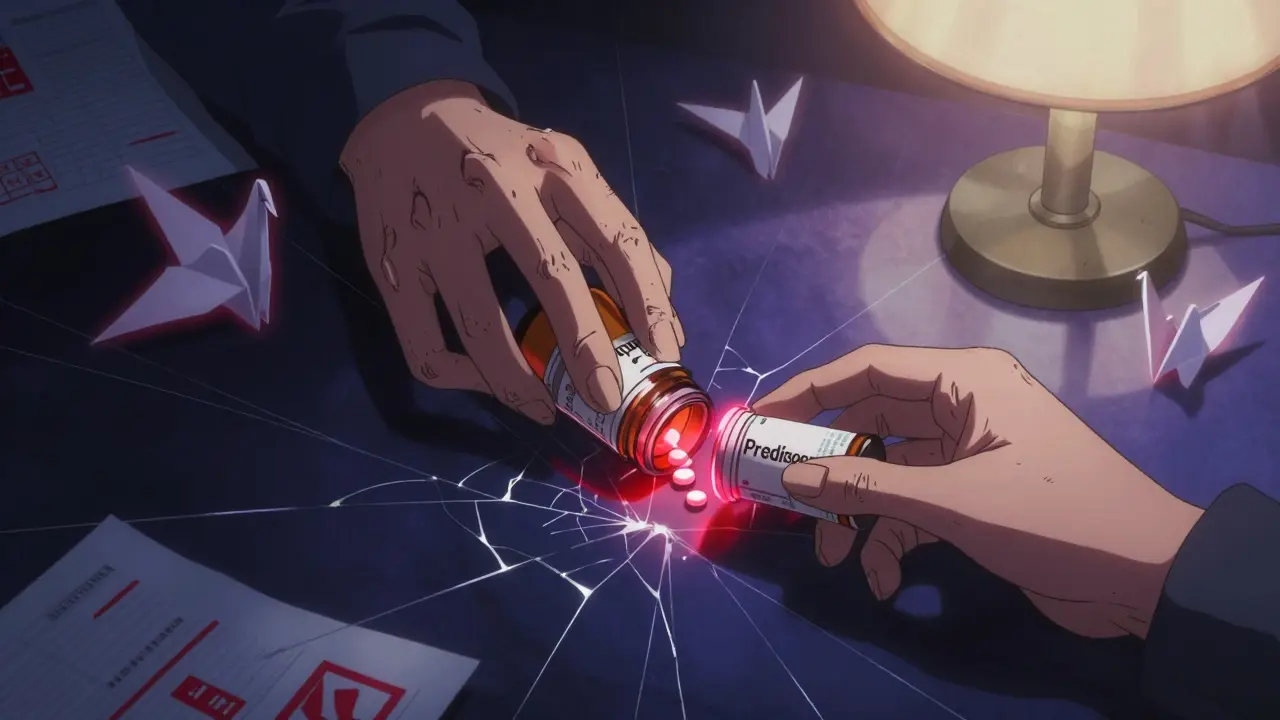
Corticosteroids-like prednisone or methylprednisolone-are anti-inflammatory drugs. They’re prescribed for arthritis, asthma, autoimmune diseases, and even allergic reactions. They’re effective. But they also weaken tendons over time by breaking down collagen, the protein that gives tendons their strength. Now, add a fluoroquinolone. These antibiotics don’t just kill bacteria-they directly interfere with tendon cells. Research shows they reduce collagen production and increase enzymes that break down tendon tissue. The result? Tendons become brittle, like old rope. When you combine the two, the risk doesn’t just add up-it multiplies. A landmark study using the General Practice Research Database found that people taking both a fluoroquinolone and a corticosteroid had a 46-fold higher risk of Achilles tendon rupture than those taking neither. That’s not a small increase. That’s a medical emergency waiting to happen.Who’s Most at Risk?
This isn’t a risk that affects everyone equally. Certain people are far more vulnerable:- People over 60: Age naturally weakens tendons. Combine that with these drugs, and rupture risk jumps 2.7 times higher than in younger adults.
- Those with kidney problems: Fluoroquinolones are cleared by the kidneys. If your kidney function is poor (eGFR under 30), the drug builds up in your body, increasing toxicity.
- Diabetics: High blood sugar damages connective tissue, making tendons more fragile.
- People who’ve had organ transplants: They’re often on long-term steroids and are frequently prescribed quinolones to prevent or treat infections.
- Those with prior tendon injuries: Once a tendon has been damaged, it’s more likely to rupture again.
Which Quinolones Are the Worst?
Not all fluoroquinolones are created equal when it comes to tendon risk. Data from New Zealand’s adverse drug reporting system shows:- Ciprofloxacin: Responsible for 67.9% of reported tendon injuries (36 out of 53 cases between 2007-2012)
- Norfloxacin: Second most common, linked to 30.2% of cases
- Levofloxacin: Much less frequently reported, but still carries the same warning
What Does a Tendon Rupture Feel Like?
It’s not subtle. People describe it as:- A sudden, sharp pain in the back of the ankle or heel
- A loud popping or snapping sound
- Inability to push off the foot or stand on tiptoe
- A visible gap or depression in the tendon area
What Should You Do If You’re on These Drugs?
If you’re taking a fluoroquinolone and a steroid together, stop. Not because you should panic-but because you need to talk to your doctor now.- Don’t ignore early signs. Pain, swelling, or stiffness in your tendons-even mild-is a red flag. Call your doctor immediately.
- Ask if you really need the fluoroquinolone. Is there another antibiotic that works just as well? Penicillins, cephalosporins, and macrolides don’t carry this risk.
- Ask about steroid alternatives. Can your condition be managed with topical steroids, physical therapy, or a lower dose?
- Stop the fluoroquinolone at the first sign of tendon pain. Don’t wait for a rupture. Discontinuing the drug early can prevent disaster.
Why Isn’t This Common Knowledge?
It’s not that doctors don’t know. They do. But fluoroquinolones are convenient. They’re cheap. They’re effective. And tendon rupture is still a rare event-about 0.1% to 0.4% of users. For a young, healthy person with a simple infection, the odds are low. But for a 72-year-old woman with diabetes, kidney disease, and rheumatoid arthritis taking prednisone? The odds aren’t low anymore. They’re terrifying. The problem is that when a patient shows up with a ruptured tendon, it’s often treated as an accident-not a drug reaction. The connection between the two medications gets missed. And without that link, the same mistake happens again.
What’s Being Done About It?
In 2013, the FDA added a black box warning-the strongest possible-to all fluoroquinolone labels. The European Medicines Agency followed. New Zealand’s Medsafe issued a public alert. Prescriptions have dropped since then. But they haven’t disappeared. Fluoroquinolones are still used for serious infections: pyelonephritis, hospital-acquired pneumonia, and infections in immunocompromised patients. They’re not going away. But they should be used with extreme caution. Researchers are now studying why some people are more vulnerable than others. Is it genetics? Metabolism? Pre-existing collagen defects? Future tests might one day identify who’s at highest risk before they even take the drug. Until then, the message is simple: Never combine fluoroquinolones and corticosteroids unless absolutely necessary. And if you’re on both, watch your tendons like a hawk.What Are the Alternatives?
For most common infections-bladder infections, sinus infections, bronchitis-there are safer options:- Trimethoprim-sulfamethoxazole for UTIs
- Amoxicillin-clavulanate for sinusitis
- Doxycycline for respiratory infections
- Cephalexin for skin infections
Final Thoughts
Medicine is full of trade-offs. But some risks are so severe, they shouldn’t be taken lightly. A ruptured Achilles tendon isn’t just an injury-it’s a life-altering event. For older adults, it can mean the end of walking without help. Quinolone antibiotics are powerful tools. Corticosteroids save lives. But together, they create a hidden danger that’s easy to overlook. The science is clear. The warnings are loud. What’s missing is awareness. If you’re taking either of these drugs, know the signs. If you’re taking both, talk to your doctor today. Your tendons might not be able to wait.Can quinolone antibiotics cause tendon rupture even after stopping the drug?
Yes. Up to 50% of tendon ruptures linked to fluoroquinolones occur after the medication has been stopped. The damage can build up over days or weeks, and the tendon may fail even after the drug is no longer in your system. This is why it’s critical to stop taking the antibiotic immediately if you feel any tendon pain or swelling.
Are all fluoroquinolones equally risky for tendon rupture?
No. Ciprofloxacin is the most frequently reported cause of tendon rupture, followed by norfloxacin. Levofloxacin appears to carry a lower risk, but all systemic fluoroquinolones carry the same FDA black box warning. No fluoroquinolone is considered safe for tendon health, especially when combined with corticosteroids.
How quickly can tendon damage happen with quinolones?
Symptoms like pain or swelling can appear as early as 2 days after starting the drug. The median time to onset is 6 days, and 85% of cases occur within the first month. Rupture can follow within days of the first symptoms. Don’t wait for severe pain-act at the first sign.
Is tendon rupture from quinolones reversible?
The tendon damage itself is not reversible. Once the tendon ruptures, surgical repair is often required, followed by months of physical therapy. Even with treatment, many patients never regain full strength or mobility. Prevention is the only reliable strategy.
Can I take a fluoroquinolone if I’m on a low dose of steroids?
Even low-dose steroids increase your risk. The 46-fold increase in rupture risk applies regardless of steroid dose. If you’re on any corticosteroid-oral, inhaled, or topical-and need an antibiotic, ask your doctor for a safer alternative. There’s no safe threshold when these two drugs are combined.
Martin Viau
December 31, 2025 AT 03:58Let’s be real-pharma’s been pushing fluoroquinolones like they’re energy drinks for bacteria. Cipro’s the OG of tendon destruction, and docs keep prescribing it like it’s a fucking magic bullet. 46x risk with steroids? That’s not a side effect-that’s a fucking death sentence waiting for a 70-year-old grandma with arthritis. Why are we still using this shit when amoxicillin exists?
It’s not ignorance. It’s greed. And someone’s gonna die because of it.
Marilyn Ferrera
December 31, 2025 AT 18:00Yes. Exactly. The data is unequivocal. The FDA warning is explicit. Yet, we continue to normalize this risk. Tendon rupture isn't 'rare'-it's underreported. And when it happens, it's dismissed as 'old age' or 'overuse.' But the mechanism? Collagen degradation. Direct. Irreversible. Preventable.
Stop calling it an 'accident.' It's iatrogenic. And we owe patients better.
Robb Rice
January 2, 2026 AT 09:13I appreciate the thoroughness of this post. The statistical breakdown is compelling. However, I must note that fluoroquinolones remain critical in cases of multidrug-resistant infections-particularly in ICU settings.
That said, the combination with systemic steroids absolutely warrants a mandatory second opinion protocol. I've seen too many patients with unexplained Achilles pain post-cipro, and no one connected the dots. We need better EHR alerts.
Brandon Boyd
January 4, 2026 AT 04:43Hey-I’m a physical therapist. I’ve seen 17 tendon ruptures from this combo in the last 3 years. All of them were preventable.
One guy was on prednisone for his COPD and got cipro for a UTI. He was walking to the bathroom. POP. Gone.
Don’t wait until you’re on crutches. Ask your doctor: 'Is there a safer antibiotic?' If they say no-get a second opinion. Your tendons aren’t replaceable.
And if you’re on steroids? Keep your calves stretched. Light walking helps. Don’t just sit there waiting for disaster.
Branden Temew
January 5, 2026 AT 19:32So let me get this straight-we’ve got a class of antibiotics that literally turn tendons into dry spaghetti, and we’re still giving them to grandmas because… what? They’re cheap? Convenient? Or maybe because the FDA’s warning is buried under 14 pages of legalese?
Meanwhile, my uncle got cipro for a sinus infection and now he can’t climb stairs. And the doctor said, 'Well, you’re old.'
Oh, so the drug didn’t do it. Age did. Right. Sure.
Frank SSS
January 7, 2026 AT 05:29Okay, but let’s be honest-how many of these people were already on prednisone for autoimmune crap? And how many of them were just lazy and didn’t want to deal with the side effects of 'boring' antibiotics?
I mean, sure, the risk is real. But people also don’t read labels. They don’t ask questions. They just pop pills and blame the drug when things go wrong.
Maybe the real problem isn’t the meds-it’s the culture of 'just fix it' medicine.
Paul Huppert
January 7, 2026 AT 10:04This is terrifying. I’m on low-dose prednisone for my RA, and my doctor just prescribed cipro for a UTI last week. I didn’t even know this was a thing.
Thanks for the warning. I’m calling my doctor tomorrow to ask about alternatives. I never realized how much I didn’t know.
Bennett Ryynanen
January 8, 2026 AT 18:18STOP. RIGHT. NOW.
If you’re on steroids and someone hands you a fluoroquinolone, say NO. Not 'maybe.' Not 'I’ll think about it.' NO.
I’ve seen people lose their mobility because their doctor thought 'it’s just a UTI.' It’s not just a UTI. It’s your Achilles. Your walk. Your independence.
Don’t let them gaslight you into thinking it’s 'rare.' It’s not rare for YOU. And you’re not a statistic-you’re a person.
linda permata sari
January 9, 2026 AT 09:16OMG I just remembered my cousin in Mexico-he was on cipro for pneumonia, and she was on steroids for lupus… she woke up one morning and couldn’t stand.
They thought she had a stroke. Turns out-her tendon just snapped. Like a guitar string.
She’s in a wheelchair now. 😭
Why isn’t this on every prescription label in giant red letters?!?!
Hanna Spittel
January 11, 2026 AT 02:01THEY KNOW. THEY KNOW. 😈
Big Pharma doesn’t care. They made billions off cipro. Now they’re just waiting for the next 'safe' drug to replace it.
Meanwhile, your grandma’s tendons? Just collateral damage. 💀
Stay woke. Don’t take the pill. Ask for amoxicillin. Or else… 🤫
Brady K.
January 11, 2026 AT 03:51Let’s not romanticize 'alternatives.' Trimethoprim-sulfa? Allergic reactions. Doxycycline? Photosensitivity. Cephalexin? Gut flora massacre.
The point isn’t that safer drugs are perfect-they’re just not *tendon-destroying*.
And yes, cipro is still the most abused antibiotic in outpatient clinics. It’s the 'I’m too busy to wait for culture results' drug.
Doctors aren’t evil. They’re overwhelmed. But we need systems-not just warnings. EHR prompts. Mandatory checklists. Mandatory patient handouts.
This isn’t a patient problem. It’s a system failure.
Kayla Kliphardt
January 12, 2026 AT 19:04I’m a nurse practitioner. I’ve had to explain this to three patients in the last month.
One woman cried because she thought her tendon rupture was 'just aging.' She didn’t know cipro was the cause.
Can we make a simple one-pager for every patient prescribed fluoroquinolones? Just a warning card?
It shouldn’t take a blog post to save someone’s mobility.
John Chapman
January 14, 2026 AT 18:30My dad had this happen. Took cipro for a UTI. Was on prednisone for gout. One morning-he couldn’t stand.
Surgeon said, 'You’re lucky you didn’t fall and break your hip.'
He’s 78. Still walks with a cane.
So if you’re on steroids and your doc says 'cipro’s fine'-ask them: 'Would you give this to your mom?'
If they hesitate? Walk out. 💪